
8 Neutral Nail Ideas with One Small Color Detail
Neutral nails with a small color detail are useful when you want a manicure that feels calm without being completely plain. Most of the nail stays beige, pink, cream or taupe, while one small mark changes the mood. A blue dot feels different from a berry curve, even when the base and placement stay exactly the same.
The eight ideas here keep the colored area limited. You can use ordinary air-drying polish or suitable flat nail stickers, depending on the design. Start with a neutral you already like wearing; the accent should add interest to that base rather than rescue a shade you do not enjoy.
Choose your neutral by appearance, not its name
“Nude” is not one universal color. A polish labeled nude may be pale pink, peach, beige, brown or taupe, and its appearance changes against different hands. Choose a base that gives the effect you want: close to your skin tone, deliberately lighter, or clearly different.
Decide whether you want a sheer or opaque result. A sheer neutral allows the natural nail to remain visible. An opaque cream creates a more uniform background for the accent. Neither is automatically neater; the important thing is to use a formula that supports the coverage you are trying to achieve.
If you often add extra layers to a pale shade because it still looks translucent, check whether that shade was designed to be sheer. Our pale-polish guide helps separate expected transparency from application streaks so you can choose a base with more confidence.

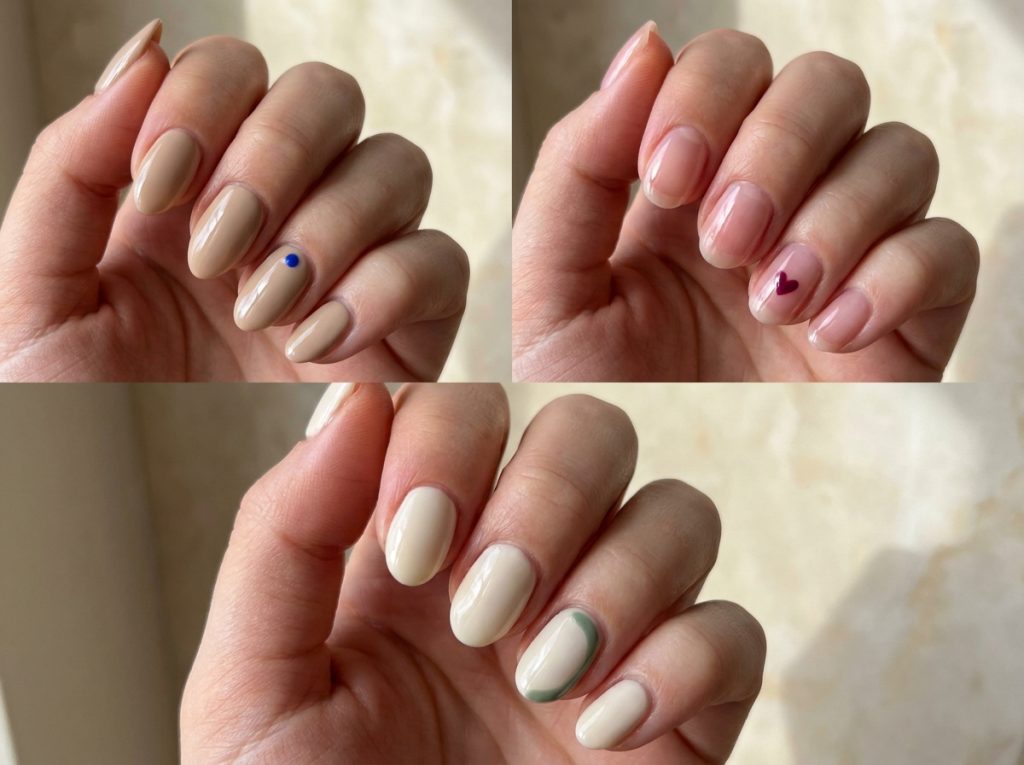
1. Beige with one cobalt dot
Paint a beige base and place one small cobalt-blue dot on each ring finger. The strong blue gives the manicure a clear accent while leaving almost all of the hand neutral. Put the dot slightly off-center if you want a relaxed arrangement.
Choose the size carefully. A tiny dot can look discreet; a larger one becomes a graphic feature. Practice the amount of polish on a tip before touching the finished nail. A tool that looks small can still make a large mark when heavily loaded.
Keep the other nails plain for the first version. If you want a second blue element, make one thumbnail fully blue rather than scattering extra dots across every finger. That gives the color a clear supporting role without making the set feel busy.
2. Sheer pink with a berry heart
Use a sheer pink base and add one small berry heart to an accent nail. A sticker can provide a crisp shape, or you can paint a simplified heart from two rounded marks that meet at a point.
The berry should be dark enough to remain visible over the pink. If both shades are close, the heart may look like a soft spot rather than a clear motif. That can be pretty, but decide whether you want a recognizable heart or an abstract mark before painting.
Place the heart with space around it and keep it away from the skin. On a narrow nail, choose a smaller sticker or use a single dot instead. Our cute accent nail guide includes a heart practice method and simpler shapes when the pointed bottom becomes difficult.
3. Cream with a short green curve
Paint a warm cream base and add a short green arc near one side of an accent nail. Olive gives a muted result, while a brighter green creates more contrast. Keep the curve open and leave cream visible around both ends.
A small curve is enough; it does not need to outline the nail. If your brush naturally makes a broader stroke, turn the design into a rounded green patch instead of forcing an extremely thin line. The palette and placement will keep the same overall feeling.
Repeat the accent on one nail per hand. You can mirror the direction or let both curves lean the same way, but choose the arrangement in advance. Similar scale and color matter more than making every bend identical.
4. Taupe with a pale blue corner
Add a small pale blue corner near the tip of one taupe nail. The combination is quieter than a bright blue dot because the colors can be closer in depth. Keep the corner shallow so taupe remains the main color.
Check the blue’s coverage over the taupe on a practice tip. A very sheer pale blue may not create a clear block. You can reverse the layering, choose a more opaque detail color or use a whole blue accent nail instead of building a thick corner.
This is a useful design when you want color that feels understated rather than playful. Keep the finish consistent across the set. A glossy taupe and glossy blue usually look more connected than two unrelated textures competing with the small color difference.
5. A warm neutral with an orange side mark
Paint a peachy beige or warm brown base, then add a short orange mark near one side of an accent nail. A rust shade creates a soft autumn direction; bright orange makes the detail more energetic.
Keep the mark compact and rounded rather than trying to draw a long stripe. It can look like a small brush stroke, which gives you more freedom than a precise geometric shape. Leave a margin from the sidewall so the color remains on the nail surface.
If the orange blends into the base too much, choose a lighter base or a deeper orange. Increasing contrast is usually more effective than enlarging the mark until it takes over the nail. For seasonal versions of this palette, see our cozy fall nail ideas.
6. Cream with three dusty-pink dots
Place three small dusty-pink dots on one cream nail in a loose triangle. This is a low-contrast accent that feels softer than a dark dot or bold block. Keep the dots separate and leave plenty of cream around the cluster.
A muted rose with enough depth will show more clearly than a very pale pink. If you want an almost hidden detail, use the paler shade deliberately. View the swatch from normal distance before deciding whether the contrast is right.
The triangle can sit toward one side of the nail rather than directly in the center. On a narrow nail, use two dots. You are creating a small rhythm, not filling a fixed template that every nail must accommodate.
7. A brown neutral with one lilac nail
Sometimes the simplest color detail is an entire accent nail. Paint most nails in a brown neutral and reserve the ring finger for lilac. The larger lilac area makes the color visible without requiring any tiny artwork.
Choose a lilac that you like beside the brown in daylight. A cooler lilac gives a stronger contrast with warm brown, while a pinker lilac can feel softer. The relationship is a matter of taste, so compare actual swatches rather than relying on color names.
If the accent feels too strong, use a lighter brown or a more muted lilac. If it feels too quiet, place lilac on two neighboring nails. Changing the proportion is a useful way to adjust the manicure without buying another shade.
8. A sheer base with a dark red mini-block
Paint a sheer neutral base and add a small dark red block near one side of an accent nail. The block can have softly rounded corners. Its compact shape gives the manicure a graphic detail while the transparent base keeps the overall result light.
Keep the red area clearly inside the nail edges. A block that crosses into the sidewall can look less deliberate and be more difficult to finish neatly. Start smaller than you think you need, then judge the whole nail before enlarging it.
Use the same red on a second accent only if the set needs more balance. One block on each ring finger may be enough. Our short color-block ideas offer related placements if you prefer simple areas of color to illustrated motifs.
Decide how many accent nails you need
One accent per hand gives the neutral base the strongest role. Two accents can work when the details are small or the colors are close in depth. More than that may still look good, but the manicure begins to read as patterned rather than mostly neutral.
Consider the position as well as the count. A ring-finger accent is easy to see when the hand is relaxed. A thumbnail accent may be more visible when holding something. Choose the position based on how you want the design to appear, not because every manicure needs the same accent finger.
Sketch the arrangement before painting. A small colored mark on a paper nail outline can help you see whether the detail is too large. This is especially useful when adapting a long-nail inspiration image to a shorter natural nail.
Use the same placement across different seasons
Once you find a layout you like, changing the accent color is enough to make it feel new. A beige base with a blue dot can become beige with a rust dot in autumn or beige with a berry dot for a richer look. The skill and placement stay familiar.
This is more practical than learning a completely new motif for every occasion. Keep a photograph of the finished arrangement and note the approximate detail size. On the next manicure, you can focus on the color relationship rather than rediscovering the placement.
For more simple arrangements, our two-color nail ideas show how the same pair of shades can be used as a single accent, neighboring accents or a repeated sequence. A small palette can produce a surprising amount of variety.
Make the accent visible in everyday light
Strong reflections can hide a tiny detail on a glossy nail. Move your hand slightly in soft daylight before deciding that the accent is too faint. A bright highlight directly over a small blue dot can make it seem less visible than it really is.
If the detail remains unclear in several lighting conditions, change either contrast or size next time. Do not automatically add a black outline; that creates a different design and can make a soft accent look much harsher. A slightly deeper detail color may be all you need.
For photographs, use a plain background and keep the whole hand relaxed. Take a closer image of the accent as well as a wider view. The wider image shows how restrained the manicure feels, while the close image explains the small colored feature.

Troubleshoot a neutral base
If the base looks uneven, address that before adding the accent. A small colorful detail will not hide a patchy background across the whole nail. Check the polish’s intended coverage, your layer thickness and whether repeated brushing is disturbing a partly drying coat.
If the neutral looks different from the bottle, compare it in another light and at the intended number of coats. Sheer colors can change noticeably with the natural nail beneath them. That is part of the finish, so a swatch on a clear tip may not perfectly predict the result on your hand.
Avoid judging a neutral by whether it makes your hands look younger or matches a universal beauty rule. The useful questions are whether you like the color, whether it gives the coverage you want and whether the accent is clear enough for your chosen style.
Common questions
Which neutral works with every accent color?
There is no single shade that looks identical beside every color or on every hand. Cream, pale pink and taupe are flexible starting points, but compare them with your actual accent. A warmer base can soften some colors and make others look more contrasting.
Can the accent be metallic?
Yes. A small metallic dot or short line can replace the colored detail. Choose a nail product intended for the effect and keep the rest of the set simple. Reflective finishes can be more noticeable than their small size suggests.
Are these designs suitable for very short nails?
Most can be scaled down, especially the single dot and whole accent nail. Use one small feature rather than shrinking several details into a crowded space. If a heart or block does not fit comfortably, choose a simpler mark instead.
What is the easiest way to refresh the idea next time?
Keep the base and placement and change only the accent color. This lets you compare the effect clearly and avoids buying several new products at once. Once you find a combination you love, repeat it without feeling that every manicure needs a completely different concept.