
Glazed vs Chrome vs Shimmer Nails: Choose the Finish You Want
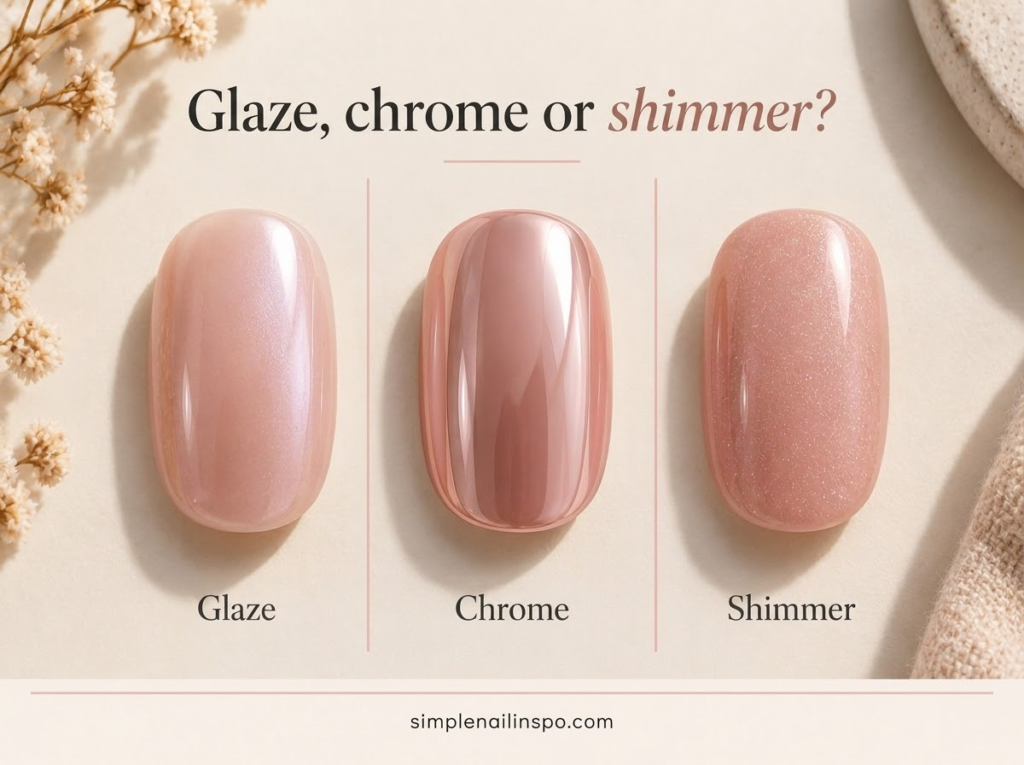
A nail photograph can look luminous, metallic or sparkly for very different reasons. “Glazed,” “chrome” and “shimmer” are often used loosely in captions, which makes it easy to choose a product and expect a finish it was never designed to create. The most useful first step is to describe the reflection you see rather than relying on the label alone.
This guide compares the appearance of those finishes and explains how to choose a clear reference for a home manicure or salon visit. It is not a universal application guide for chrome powder or gel. Product systems differ, and their instructions determine compatible layers, curing requirements and removal.
Start with what the light is doing
Look at an image of the manicure and ask three questions. Can you see a strong smooth reflection? Does the nail have a soft cloudy glow? Can you see individual reflective particles? These observations tell you more than a caption that simply calls everything chrome.
A finish can also combine qualities. A pale manicure might have a soft pearly glow and a few visible shimmer particles. A metallic lacquer might create a strong reflective band without looking like a true mirror. The categories are useful descriptions, not rigid boundaries that every product must fit perfectly.
Lighting matters too. A direct bright light can make a soft finish look more reflective, while diffuse light can make a metallic surface look quieter. Compare several images or a physical sample when the exact effect matters to you.
| Finish direction | What to look for | Useful description |
|---|---|---|
| Glazed or pearly | Soft luminous sheen | A gentle pearl glow with the base still visible |
| Chrome or mirror-like | Strong smooth reflection | A reflective metallic surface without obvious glitter |
| Shimmer | Fine reflective particles | A colored polish with a visible fine sparkle |
| Glitter | More distinct particles or pieces | Noticeable sparkle and particle texture |

What a glazed look usually means
A glazed look generally suggests a soft luminous surface rather than a sharply mirrored one. The base color often remains visible, with a pale reflective effect above it. Pink, cream and milky shades are common visual starting points, but the idea can be adapted to other colors.
The word describes an appearance more than one guaranteed formula. Some ordinary lacquer toppers are designed to create a glaze-like effect, while other looks use professional effect products within a particular system. Check the actual product directions rather than assuming every glazed manicure needs the same process.
When choosing a reference, notice the opacity. A sheer pink glaze can show the natural nail beneath it, while an opaque white base with a pearly effect looks more uniform. If you want the first result and choose the second base, the manicure may feel much heavier even if the surface sheen is similar.
Who might prefer this direction?
Choose a soft glaze when you want reflection that does not dominate the whole manicure. It can work well with a mostly neutral set or one reflective accent among plain nails. The visual effect is often easier to combine with small details because it leaves the underlying color relatively clear.
That does not mean it is automatically easy to apply. A pale base can still show streaks, and an effect layer can still be uneven. Our pale-polish application guide helps with the base decisions before you add a reflective finish.
What a chrome look usually means
Chrome commonly describes a stronger metallic or mirror-like reflection. The surface may look smoother and more sharply reflective than a fine shimmer polish. Silver is an obvious example, but the overall color can change with the base and effect product.
Do not assume a bottle labeled metallic will reproduce a powder-based mirror result. Some metallic lacquers show visible brush direction or fine particles, which can be attractive but different. Look at swatches that show the finish clearly and check what product system created them.
If the effect uses powder within a gel system, the correct base, top layer, lamp and timing are product-specific. A curing time from one tutorial is not a general rule for another product. For a simple home manicure, you can choose an air-drying reflective lacquer instead and accept that its finish may differ from the reference.
How to make chrome less dominant
Use it on one or two accent nails and keep the others in a related plain color. Silver beside gray, champagne beside beige or reflective pink beside dusty rose can create a clear relationship without covering the entire hand in a strong reflection.
You can also choose a softer color direction rather than adding more artwork to distract from the shine. Our chrome color ideas compare pale pink, silver, champagne, blue and deeper options so you can decide how much contrast you want.
What shimmer means in practice
Shimmer usually involves fine reflective particles that catch the light within the polish. The base color may remain very clear, with a subtle sparkle appearing as the hand moves. Some shimmers are delicate; others are dense enough to look metallic from a distance.
Check the particle size in close photographs. Fine shimmer can give a smooth-looking glow, while larger particles become more individually visible. A product image under a bright lamp may exaggerate the sparkle compared with ordinary daylight, so look for more than one lighting condition if possible.
Shimmer can be a useful home-polish option because the effect may be built into a single color product. That does not eliminate the need to follow its application directions, but it avoids assuming you need a separate powder or unfamiliar curing system to make a manicure reflective.
When shimmer is a good design choice
Choose shimmer when you like seeing the base color and want reflection distributed through it. A berry shimmer can still read clearly as berry, while a strong mirror effect may change the impression more dramatically. Use one shimmer accent beside plain nails if you want to compare the finishes directly.
Keep the surrounding details simple at first. Fine sparkle can become visually busy when combined with several small motifs, especially in photographs. A whole shimmer nail often reads more clearly than a tiny shimmer line that is difficult to see.

Why the base color changes the result
An effect layer does not always hide what is beneath it. A pale base can make the final result look brighter, while a dark base can create a deeper or more contrasting effect. The exact change depends on the product, so a swatch over white is not a reliable preview of the same effect over chocolate brown.
Ask to see a sample using a base close to the one you want. If you are working with ordinary lacquer at home, test the compatible topper on a spare tip over your chosen color. Record the layers you used so you can repeat the result instead of guessing later.
Opacity is another variable. One sheer base layer may leave the natural nail visible; a more opaque base can make the color uniform. Decide whether that transparency is part of the look you want before adding more product to remove it.
Describe the finish clearly at a salon
Bring a reference image and explain the specific qualities you like. You might say that you want a pale pink base, a soft pearly reflection and no visible glitter. Or you might want an opaque silver mirror-like finish on every nail. Those descriptions are more useful than a single broad label.
Also identify the parts you do not need copied exactly, such as the model’s nail length or shape. A finish can be adapted to your own nails without reproducing a long extension set. Ask how the reflection will look on your chosen shape and whether a sample is available.
Discuss the product system and removal method separately. The visual reference tells the technician what you want to see; it does not specify the safest or most suitable service for your nails. Follow professional and manufacturer guidance rather than treating a social-media caption as a technical instruction sheet.
Choose a manageable home version
If you use ordinary polish, start with a lacquer or compatible topper explicitly intended for air drying. Read the label and application directions. A phrase such as “gel-like shine” does not automatically mean the product needs a lamp, and a true gel product should not be treated as ordinary lacquer.
Make a test swatch before painting all ten nails. Look at the result in daylight, under your usual room light and from a normal viewing distance. This tells you whether the effect is strong enough, whether the base remains visible and whether the finish shows brush marks you did not expect.
Choose the simpler design for the first attempt. One reflective accent among plain nails is a useful trial because you can judge the finish without making it the whole manicure. Our mix-and-match nail plans include a restrained reflective accent set that keeps the palette small.
Read inspiration photographs critically
A close-up image can make a tiny reflective detail look much larger than it appears in daily life. Check whether the photograph shows the entire hand as well as the surface texture. The wider view helps you judge how bold the finish really is.
Filters and color grading can change pink, silver and gold tones. A warm filter may make silver look champagne, while a cool filter can make pale pink look almost white. Use several references when the exact color matters and avoid expecting one edited image to function as a precise swatch.
Look for the position of the light reflection. A broad white stripe across the nail may be reflected lighting rather than painted nail art. If you are unsure, choose a reference with more than one angle or a short video that shows the surface moving.
Keep the design coherent
When mixing finishes, repeat the color family. A pink shimmer accent beside plain pink nails is easy to understand. Combining unrelated colors, different particle sizes and several motifs can work, but it requires more planning than a simple finish comparison.
Use plain nails as a visual pause. They make the reflective accent easier to notice and can keep a bold finish comfortable for everyday wear. One accent does not make the manicure incomplete; it gives the effect a clear role.
If the set feels too busy, remove artwork before changing the finish. A reflective nail may need no extra dot or stripe. Let the changing light be the detail, especially when the surface already has a strong mirror-like effect.

Build a small finish reference set
If you enjoy experimenting with lacquer, keep a few labeled practice tips showing finishes over the same base. One plain tip, one with a compatible pearl effect and one with shimmer make the differences easier to judge than unrelated product photographs. Record the actual products and application sequence rather than relying on memory.
View the set near a window and under your usual indoor light. Notice which finish still shows the base color, which becomes more reflective and which reveals individual particles. This small reference collection helps you choose a future manicure based on an effect you have seen yourself, without needing to buy several similar products each time a new descriptive name appears online.
Common questions
Are glazed and chrome nails the same?
The terms can overlap in casual use, but they often describe different levels of reflection. Glazed usually suggests a softer luminous effect, while chrome suggests a stronger metallic or mirror-like surface. Use a visual reference and a description of the reflection to avoid ambiguity.
Is shimmer the same as glitter?
They are related reflective effects, but shimmer usually refers to finer particles and glitter to more distinct visible pieces. Products vary, so compare close-up swatches rather than relying only on the label. The particle size changes how busy or smooth the finish appears.
Can I put any topper over any polish?
Do not assume compatibility. Check the product’s intended use and the directions for the base and finishing layers. A topper designed for ordinary lacquer and a product designed for a specific gel system are not interchangeable simply because they create similar colors.
Which finish should I try first?
Choose the effect you like in ordinary light and a product system you already understand. For a low-commitment visual trial, use one accent nail. If you want a finish that requires an unfamiliar professional process, discuss it with a qualified nail professional instead of improvising the system.