20 Minimal BIAB Nail Art Ideas: Tiny Flowers, Dots, and Fine Lines
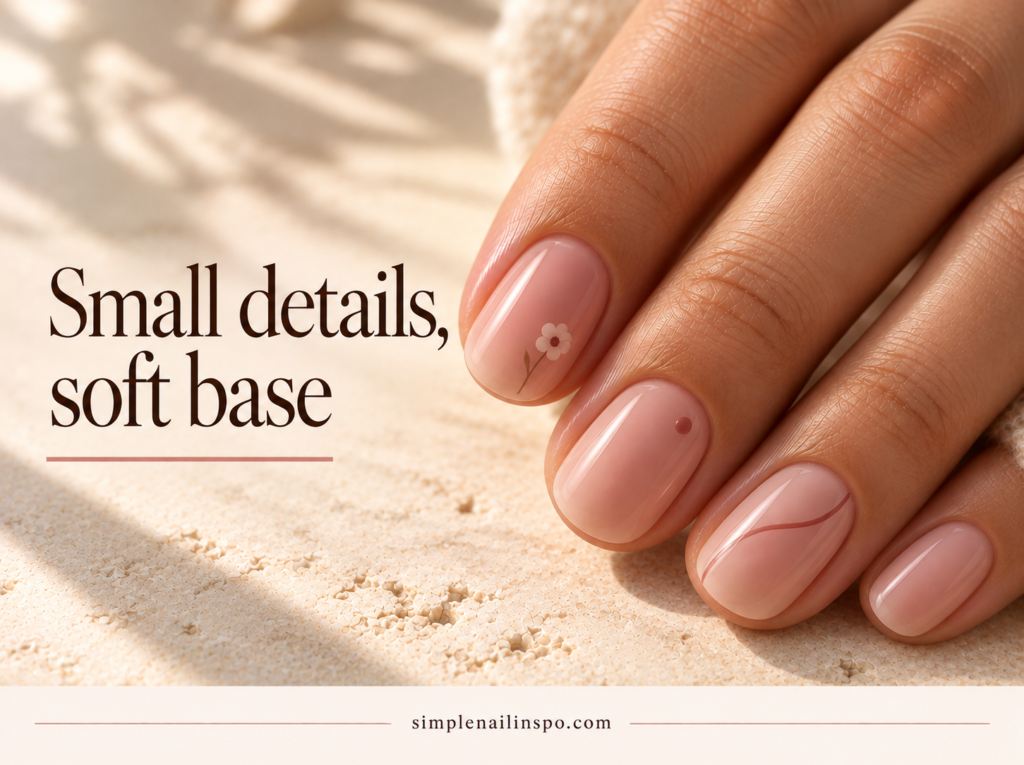
Minimal nail art is mostly an exercise in placement. The same tiny flower can look delicate beside the tip and crowded in the middle of a small nail. A single line can give a whole manicure direction, while three unrelated details can make it feel busier than intended.
These 20 minimal BIAB nail art ideas use a simple base with small, clearly placed marks. The designs focus on dots, flowers, lines, and little geometric accents. Each can be adapted to a short nail by reducing the number of elements rather than squeezing everything into a smaller space.
BIAB™ is The GelBottle’s branded builder range; the artwork is a separate visual choice. Tell your technician which product service you want, then show the motif and placement you like. A similar-looking design can sit over several different manicure systems.
Choose your version
Choose one family of marks before choosing colors. Dots feel playful, thin lines look more graphic, and small flowers introduce a recognizable motif. Mixing them can work, but a first minimal set is easier to balance when one shape leads.
Then decide how many nails should carry art. Two accent nails can provide enough interest for a whole hand. Repeating a very small mark on every nail creates rhythm, but it also increases the total visual activity. Keep a plain base visible around each design so the art has room.
| Your priority | Looks to consider | Detail to specify |
|---|---|---|
| The smallest possible accent | 1–4 | Dot size and spacing |
| Something softly floral | 5–8 | Petal count and position |
| A graphic manicure | 9–12 | Line direction and thickness |
| A tiny recognizable symbol | 13–16 | One clear silhouette |
| A coordinated accent set | 17–20 | Repeat one design rule |
Dots with breathing room
1. One dark dot on sheer pink
Place a tiny chocolate or charcoal dot in the lower third of one ring fingernail. Leave the other nails softly pink and glossy. The dark point gives the manicure a clear accent without requiring a pattern.
Keep it away from the skin and slightly off-center for a relaxed effect. A centered dot repeated on every finger feels more geometric; choose that only if you want a stronger rhythm across the hand.
2. Three graduating dots
A short trail of three dots, from small to smaller, creates movement on a neutral accent nail. Angle the trail toward one corner rather than straight through the middle. Use a single color so the change in size remains the main idea.
Leave a visible gap between the dots. If they touch, the delicate trail becomes a little line or cluster, changing the character of the design.

3. White dot at the tip
Put one tiny white dot close to the free edge of each nail. A translucent beige base keeps the design light and makes the white visible without high drama. This is a playful alternative to a complete French tip.
Match the dot’s visual size to each nail. The pinky usually needs a smaller mark than the thumb. Consistent placement matters more than forcing every dot to have an identical diameter.
4. Two-color dot pair
Place one dusty rose dot beside one muted brown dot on a single accent nail. The colors should have a clear difference but similar softness. Leave the rest of the manicure a plain neutral shade.
The pair can sit diagonally or horizontally. Try a diagonal arrangement on a narrow nail because it uses the available space more gently. Resist adding a third dot unless the first two genuinely need more room to communicate the idea.

Tiny botanical details
5. One miniature daisy
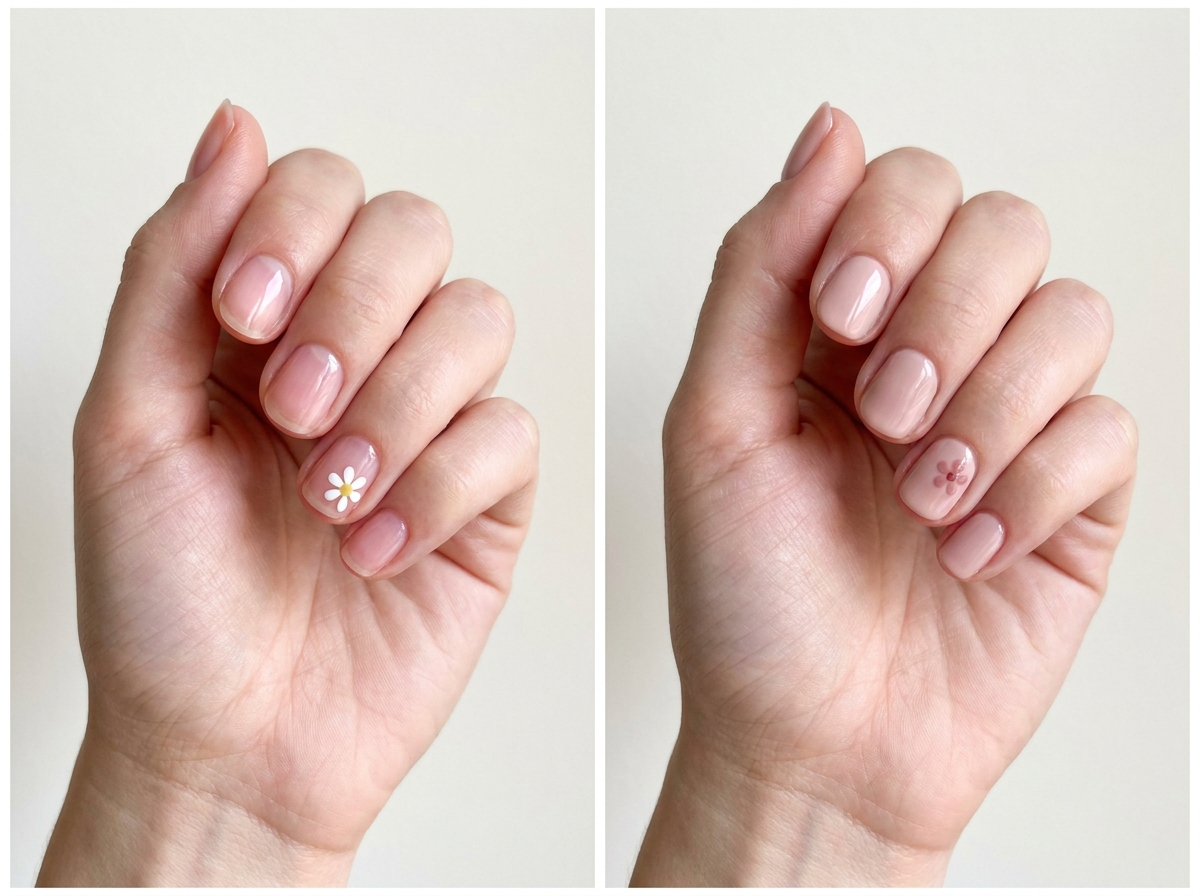
A small white daisy with a muted yellow center feels cheerful against a sheer pink base. Put it near one side of the ring fingernail, leaving the middle open. A simple flower silhouette is enough; it does not need a stem.
Choose a daisy small enough to remain an accent but large enough for the petals to stay distinct. If the nail is very short, move the flower to the thumbnail rather than making it unreadably tiny.
6. Dusty rose petal flower
Use dusty rose petals and a slightly deeper rose center for a tonal flower. The lower contrast makes the motif quieter than a white daisy. Keep the base neutral pink and repeat the flower on only one or two nails.
A side placement allows one petal to approach the edge without filling the nail. This gives the flower a casual, cropped appearance while preserving enough open base for the design to feel minimal.
7. Tiny olive sprig
A fine short stem with two small olive leaves makes a restrained botanical accent. Angle it along one side of a warm nude nail. The narrow silhouette fits a compact shape more naturally than a large central leaf.
Keep the green muted and the stem delicate. If the line becomes too dark or thick, the sprig can look like a stripe with decorations attached. The leaves should be the recognizable part.
8. Cropped corner blossom
Let a small blossom emerge from one corner of the nail, with only part of the flower visible. This placement uses the edge as part of the composition and keeps the center clear. Cream petals over beige create a soft version.
Use the same corner on one accent per hand for a coordinated set. A cropped motif can be more forgiving visually than trying to center a full flower on a very small nail bed.

Fine lines and quiet curves
9. Single vertical hairline
A fine dark line running through part of the nail adds lengthwise direction. Start it above the base and stop before the tip so it feels like an accent rather than a division. Use it on one or two nails.
A slightly off-center position looks relaxed; a perfectly centered line feels more formal. Choose one approach for the whole set. Mixing both without a plan can make a simple manicure seem unintentionally uneven.
10. Short diagonal gold line
A small gold-colored diagonal near the tip adds a flash of light to a sheer nude manicure. Keep the line short and leave it isolated. The design works through restraint, with the metallic detail appearing only when the hand moves.
Ask whether you prefer a painted metallic line or another salon technique that gives the same visual effect. The important choice is a smooth, small accent with no loose or raised edge.

11. Soft white side curve
A slender white curve follows one side of a pink nail without becoming a complete outline. Let it taper as it approaches the tip. This gives a sense of movement while leaving most of the base uninterrupted.
Use only one curve per accent nail. Adding a second parallel curve changes the look into a more obvious swirl design, which can still be attractive but feels less restrained on a short shape.
12. Tiny taupe half moon
A small taupe crescent near the lower edge of a neutral nail creates a quiet graphic accent. The color should be only moderately deeper than the base. Keep the arc fine and leave a clean margin near the skin.
This is a useful alternative to a tip design when your nails have almost no free edge. The decoration sits within the nail bed, so it does not depend on having visible length beyond the fingertip.

Small symbols and shapes
13. Miniature burgundy heart
A single burgundy heart gives a pale nude manicure a small point of color. Position it near one upper corner, with the point facing toward the base. The shape should be recognizable without becoming the entire nail design.
A muted wine shade feels quieter than bright red. For an even subtler version, use dusty rose and keep the rest of the set completely plain.
14. One fine star
A small four-point star in white or pale gold adds a delicate sparkle motif without actual glitter. Place it on a clear-looking accent nail and leave enough space around the arms. The clean silhouette matters more than the number of points.
If the artist recommends a slightly larger star for clarity, use fewer stars across the hand. One crisp motif is more effective than several tiny marks that lose their shape.

15. Open oval accent
A fine open oval on one nude nail gives an abstract, jewelry-like detail. It can sit slightly tilted and off-center, with the interior left clear. A soft brown outline feels more understated than black.
Keep the oval small enough to have space on all sides. On a short nail, an elongated shape can echo the nail’s direction without pretending to add actual length.
16. Tiny cream square
A small cream square on a beige or rosy base introduces a geometric detail without strong contrast. Position it near a side edge rather than directly in the center. The pale-on-pale combination makes the design a close-up discovery.
Ask for a visibly square silhouette with clean corners. If the shape is too small to hold its geometry, a dot will communicate a more deliberate result than a blurred miniature square.

Minimal art across a whole hand
17. Matching dots on two fingers
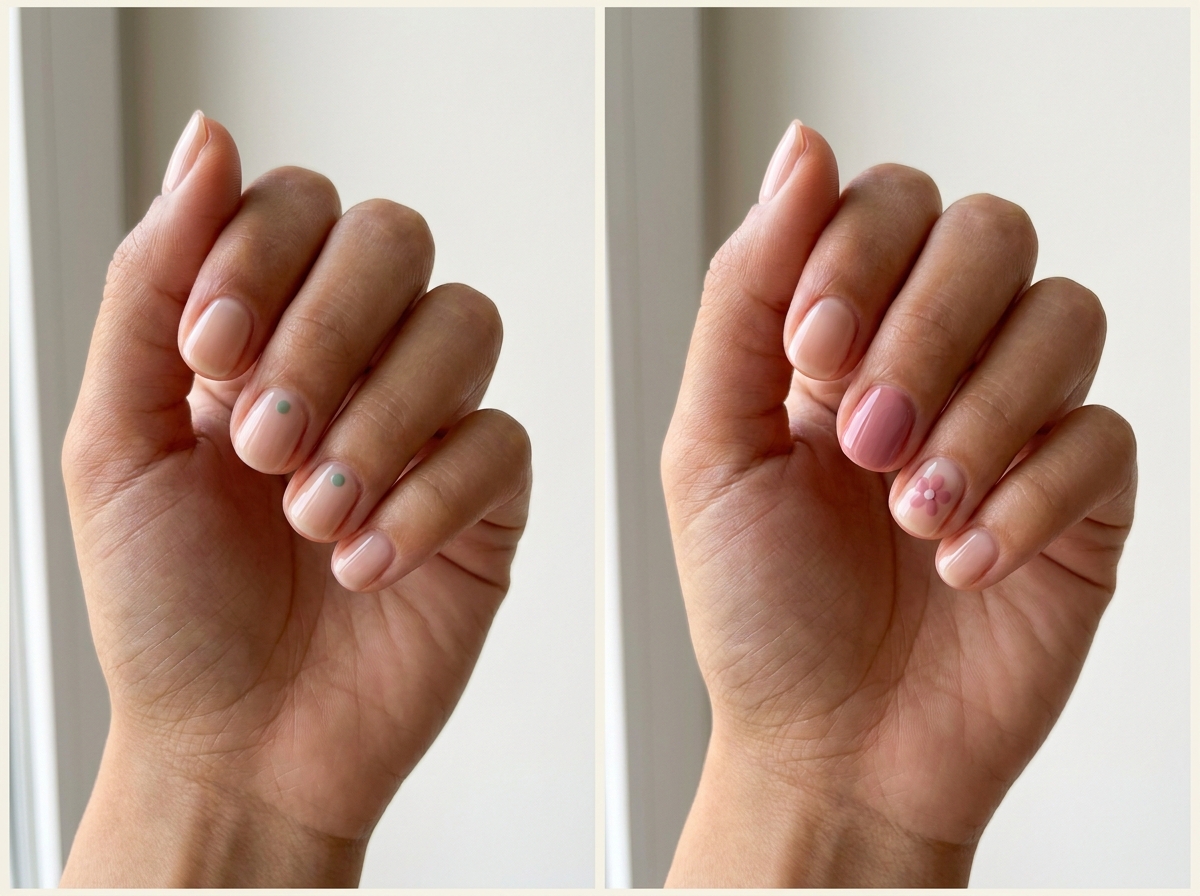
Place one identical muted green dot on the index and ring fingernails, leaving the other nails plain. Repetition connects the accents without requiring every finger to carry art. A neutral base keeps the green easy to read.
Keep the dots at the same approximate height for a tidy effect. If you prefer a looser arrangement, change the positions intentionally but retain the same size and color so the relationship remains clear.
18. One flower and one plain color accent
Pair a tiny pink flower on a nude ring fingernail with one plain dusty-pink nail nearby. The solid color repeats the petals and gives the set a clear palette. All remaining nails stay neutral.
Choose the plain accent before adding more flowers. It often supplies enough balance on its own. This is a useful way to make a minimal manicure feel coordinated without repeating the exact motif across the hand.
19. Alternating dot and short line
Use a dot on one accent nail and a short line on another, both in the same brown. The shared color ties the different marks together. Keep their visual weight similar so neither dominates.
Leave at least three nails on each hand plain. The empty space is what makes the two marks feel like small design decisions instead of the beginning of a larger abstract pattern.
20. One continuous design idea in different positions
Repeat a tiny white crescent on three nails, moving it from a side corner to the tip and then slightly lower. The shape remains constant while the placement changes. A sheer pink base makes the set feel cohesive.
Plan the sequence before painting so the movement looks intentional. The other two nails can remain plain, giving the eye space between repeated details and keeping the overall manicure light.

Make small nail art look intentional
Scale the motif to the smallest canvas
A reference photographed on a long almond nail may need a different arrangement on a short square. Keep the recognizable part of the design and remove supporting details. A flower can lose its stem, a star can become a single four-point shape, and a sprig can use two leaves instead of six. Reducing the number of marks usually works better than shrinking every element.
Choose contrast before adding more art
If a detail seems too quiet, try a slightly deeper color before requesting another motif. A small chocolate dot can be more legible than several pale beige ones. If it feels too bold, lower the contrast or move it closer to a side. These adjustments preserve the idea while changing how strongly it reads.
Make a ten-nail map
Describe the set finger by finger, especially when the hands differ. For example: one flower on the left ring finger, one matching dot on the right index finger, all other nails plain. This avoids adding extra accents simply because an empty nail feels unfinished during the appointment. Plain nails are part of a minimal design.
More ways to simplify a reference
Our guide to nail-art tools explains the visual role of common tools for basic polish art. For seasonal motifs that can be reduced to one accent, browse October nail ideas for beginners. Keep professional builder application and any gel-product instructions separate from simple decorative inspiration.
Frequently asked questions
How many accent nails should a minimal manicure have?
There is no fixed rule, but one or two per hand is a useful starting point. Repeating a tiny mark on every nail can also feel minimal if the contrast is low. Consider the whole hand, not just the complexity of one nail.
Can small nail art be done over a BIAB overlay?
Your technician can advise on compatible decorative products and the correct sequence for the system used. The visible design does not establish which builder sits beneath it. Confirm BIAB separately if that specific branded service is what you want.
Which motif suits very short nails?
A single dot, short line, small corner flower, or narrow crescent uses little space. Choose the detail you can still recognize at a comfortable size. A simpler shape is usually more readable than a complicated design compressed onto a small nail.
Does minimal nail art have to use neutral colors?
No. A tiny cobalt dot or burgundy heart can still be minimal. The amount of color, its placement, and the space around it matter more than whether the shade is neutral. Limit the palette when you want a bright detail to feel controlled.
Choose the one mark you most want to see on your hands, then give it space. A minimal manicure feels complete when every accent has a reason to be there.